


Project: Richmond Greenway
A Greenway with Purpose

The Richmond Greenway is more than a trail through the city. Built along a former Santa Fe railway corridor, the multi-use path creates a continuous green space through a highly urbanized part of Contra Costa County. Along the corridor, gardens, trees and restored habitat provide places where people and nature can connect.
For CCRCD EcoStewards, the Greenway offers an opportunity to bring conservation into an everyday community setting. Rather than requiring people to travel to a remote natural area, native plants and wildlife habitat can be experienced along a route used by walkers, bicyclists, families and neighborhood residents.
CCRCD supports this vision through hands-on habitat stewardship, environmental education and collaboration with community organizations. The work demonstrates that ecological restoration does not have to happen far from where people live. Even small patches of habitat can become meaningful parts of a larger urban ecosystem.
Stewardship on the Greenway

CCRCD EcoStewards maintain an adopted area along the Richmond Greenway, turning an urban space into an opportunity for hands-on conservation. The work includes planting native species, removing invasive vegetation and litter, maintaining established plants and coordinating with neighboring groups.
These tasks may seem small individually, but regular maintenance is essential for restoration to succeed. Native plants need room to establish, invasive species need to be managed and gardens need continued care as seasons change.
EcoStewards also bring technical knowledge to the work, helping identify plants, recognize habitat needs and determine where additional attention is needed. Their presence provides continuity between individual volunteer events and the long-term health of the site.
The Greenway demonstrates an important part of CCRCD's stewardship approach: conservation is not simply about creating habitat once. It is about returning to that habitat, caring for it and helping it become a lasting part of the community.
Growing Native Habitat

Native plants are transforming portions of the Richmond Greenway from formerly hard or weedy spaces into small pockets of habitat. CCRCD's adopted area includes native forbs and shrubs selected to provide ecological value while adapting to an urban environment.
Plants such as California poppy, sticky monkey flower and other California natives offer food and shelter for insects while adding seasonal color and diversity to the corridor. As vegetation becomes established, the garden develops layers that provide different resources throughout the year.
EcoStewards help maintain this diversity by giving native plants the space and conditions they need to thrive. That can mean removing aggressive non-native grasses and weeds while recognizing that not every spontaneous plant needs to be removed.
The goal is not to create a perfectly manicured garden. It is to develop a functioning patch of native habitat that can coexist with an active public trail and contribute to the Greenway's larger ecological network.
Creating a Pollinator Pathway

A native plant garden can become a valuable stop for pollinators moving through an otherwise highly developed landscape. At the Richmond Greenway, EcoStewards cultivate plants that provide nectar, pollen and habitat for bees, butterflies and other insects.
The benefits extend beyond individual flowers. Native plants support insects at different stages of their lives, while the insects themselves become food for birds and other wildlife. A diverse planting can therefore help connect several levels of the urban food web.
The Greenway's pollinator gardens also give residents a chance to observe these relationships close to home. A butterfly visiting a flower, a bee moving between blossoms or a bird searching through vegetation can turn an ordinary walk into an outdoor lesson in ecology.
By maintaining native plant habitat along a public corridor, EcoStewards help create stepping stones for pollinators while showing how even small urban landscapes can contribute to biodiversity.
More Than Flowers

The value of the Greenway's native vegetation extends well beyond pollinators. Insects and caterpillars supported by native plants become food for birds, while dense vegetation provides shelter for species such as songbirds, hawks, fence lizards and small mammals.
These connections illustrate how an urban garden can function as more than an attractive collection of plants. Each layer contributes something different, creating a miniature ecosystem within a landscape dominated by pavement, buildings and other developed areas.
EcoStewards help maintain the vegetation that makes these relationships possible. By protecting plant diversity and managing invasive growth, they support habitat that can serve wildlife throughout the year.
The Greenway can also benefit surrounding communities in less visible ways. Native vegetation and pollinators contribute to healthier urban landscapes, while nearby gardens and orchards can benefit from the insects moving through the corridor.
Community Stewardship
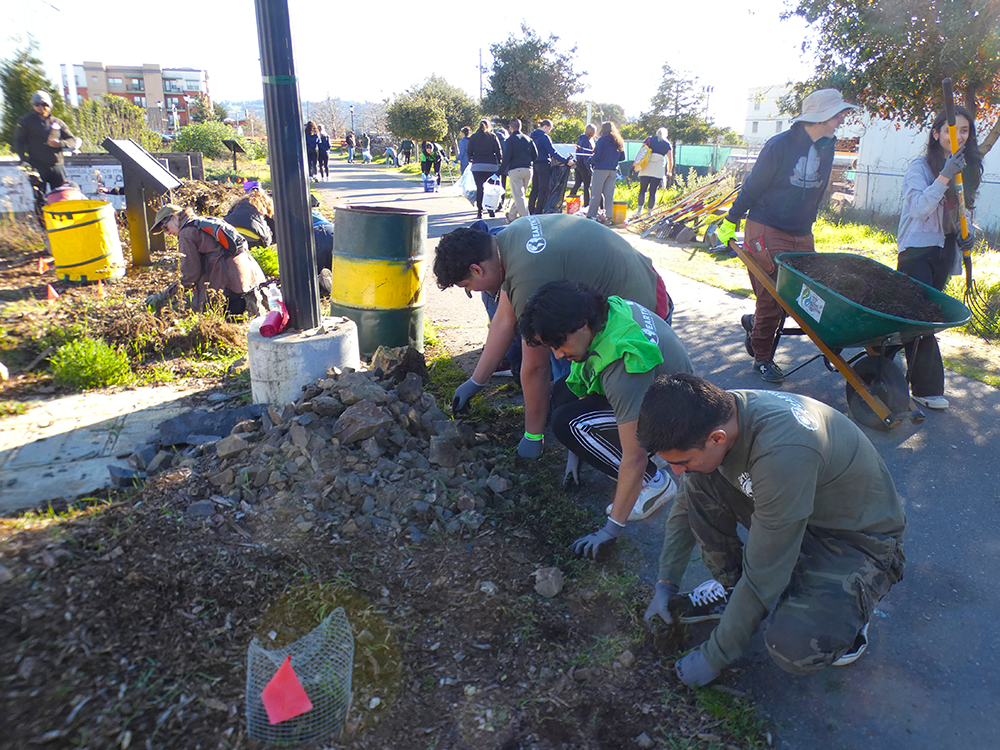
The Richmond Greenway is shaped by the people who care for it. CCRCD works alongside community organizations, volunteers and youth groups to turn restoration into a shared activity rather than something done behind closed gates.
Workdays can bring people together to plant natives, remove invasive vegetation, pick up litter, maintain gardens and improve the appearance and function of the corridor. Partners such as Friends of the Richmond Greenway and Earth Team have helped create opportunities for residents and young people to participate directly in stewardship.
These events also make conservation more accessible. Participants do not need to be professional ecologists to contribute. They can learn by planting a shrub, identifying a native species or simply seeing how a neglected space changes through continued care.
For EcoStewards, community involvement strengthens the restoration itself while building relationships between people and the places they share.
Stewardship and Opportunity
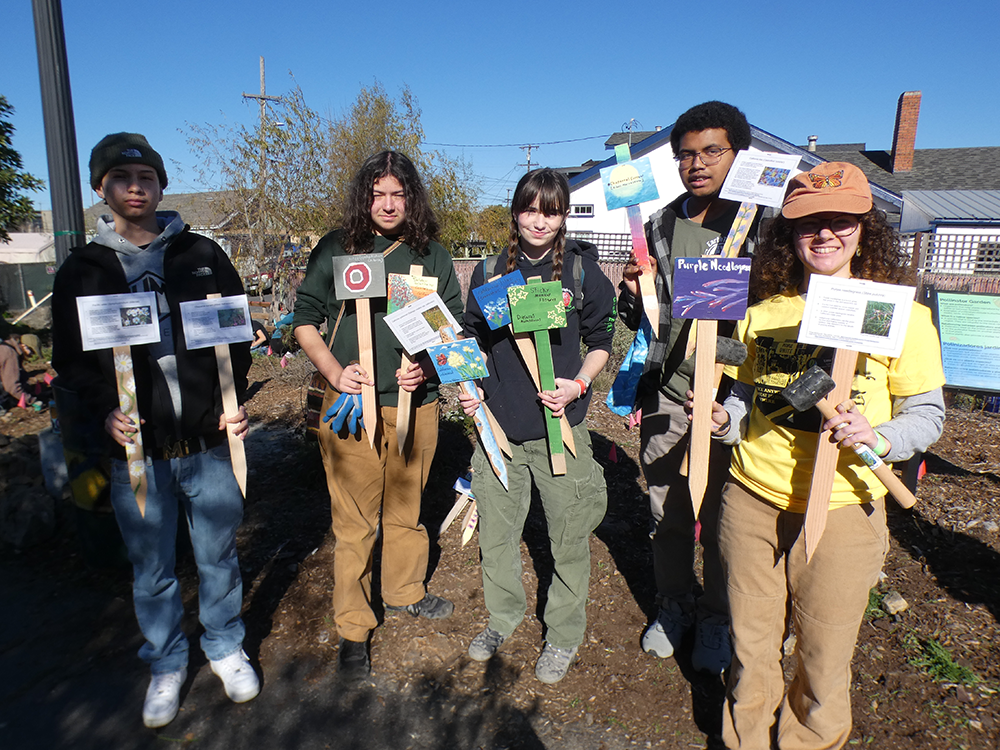
The Richmond Greenway demonstrates how environmental restoration and community opportunity can reinforce one another. In a city shaped by a long history of environmental justice activism, creating healthier green spaces can provide benefits that extend beyond habitat.
CCRCD's work with community partners has included environmental education, youth engagement and opportunities to build practical knowledge about plants, watersheds and urban ecology. Programs such as Creeks and People connect ecological learning and workforce development, helping participants gain experience caring for native landscapes.
The Greenway also carries the legacy of community members who envisioned turning an abandoned railway corridor into a public green space. Today, EcoStewards and their partners continue that tradition by caring for the landscape and helping residents participate in its future.
The result is more than a restored garden. It is a place where conservation, education, recreation and community stewardship meet—demonstrating that healthy ecosystems can grow alongside healthy communities.

Ben Weise
Skills: Permitting, conservation on agricultural land, illegal dumping prevention.
Fun Fact: Eagle Scout, former member of the University of California Marching Band, aspiring birder, and a Contra Costa native raised in Southern California.
Ben Weise
Ben started working with Contra Costa RCD in January 2017 after receiving two Masters degrees from Indiana University in Natural Resource Management and Environmental Policy following undergraduate studies at UC Berkeley. Ben manages the Voluntary Local Program, the EcoStewards Program, and other conservation programs focused on agricultural lands.

Adam Gelfand
Skills: Field Data Collection, Tree Physiology, Habitat Monitoring, Outreach.
Fun Fact: Loves to cook Middle Eastern food, surf, write folk music, and doesn't think the wilderness exists.
Adam Gelfand
Adam grew up in New Jersey where they spent their childhood looking for bugs and coming up with new names of plants. Their first ecological position was selling Christmas trees as a teen. Afterwards, they went to Warren Wilson College in Asheville, NC where they spent four years working on an organic vegetable farm and earning a degree in Environmental Education. Seeking a way to be of service during the pandemic, they then moved to New York City to teach conservation biology to communities traditionally underserved by environmental education. Adam has grown to identify as an ecologist and conservationist who sees the world through the eyes of trees. They recently earned a graduate degree where they studied the relationship between Indigenous fire history, carbon sequestration, forest compositional shifts, and tree rings. Adam is excited to join CCRCD and face all the exciting challenges that come with restoring habitats.

Jules Mackey
Skills: Camera trapping, California wildlife and plant identification, data management, conservation education.
Fun Fact: Loves birding, rock climbing, fashion, hiking, and cooking Filipino food.
Jules Mackey
I grew up spending a lot of time exploring nature in my hometown, San Diego, and while camping throughout the western United States.
My passion for conservation led me to pursue an education at UC Davis, where I graduated in 2022 with a B.S. in Environmental Science & Management, and a minor in Wildlife, Fish, and Conservation Biology. Prior to joining CCRCD, I've performed field monitoring in the Delta and Bay area. At CSTARS, I collected GPS points of native and invasive plant species in the Delta in order to develop aerial vegetation identification tools. As a field researcher with the UC Davis Road Ecology Center, I collected camera-trap data and analyzed the impacts of Interstate 580 on East Bay wildlife communities.
I'm driven by a passion for urban ecology, environmental justice, and the restorative power of nature to communities and people. I am excited to bring my skills and passion to my work with CCRCD.

Elena Rich
Skills: California wildlife and plant identification, wildlife camera trapping, heavy equipment and power tool operation, community engagement and education, data management.
Fun Fact: Loves birding, gardening, hiking, tidepooling, and game nights with friends and family.
Elena Rich
Elena grew up in the East Bay and spent much of her childhood hiking and exploring the local oak woodland open space, where her love of nature developed.
Elena is fascinated by the challenge of stewarding habitat in novel ecosystems. She studied at UC Davis, receiving a B.S. in Environmental Science and Management in 2024. While in college, she worked at the UC Davis Arboretum and Public Garden for three years, first at the nursery and later as a waterway stewardship apprentice at the Arboretum Waterway. There, she gained experience in plant care, restoration, wildlife monitoring, and habitat management in a human-dominated landscape.
Elena began working at the CCRCD in 2024. She has enjoyed exploring and stewarding new areas of her home county, such as Dutch Slough in Oakley. Working outside nearly every day, she is grateful to have the opportunity to foster such an intimacy with the ecology of Contra Costa County.

Molly Clemons
Skills: Habitat restoration, invasive weed control, California wildlife and plant identification, natural resource management, ArcGIS mapping software.
Fun Fact: Enjoys hiking, birding, gardening, and kayaking
Molly Clemons
Molly is an Ecosteward Conservation Technician. She received a B.S. in Environmental Science at Sonoma State University in 2023. She served with AmeriCorps, California Climate Action Corps at St. Mary's College in Moraga CA, during the past year. As a California Climate Action Corps fellow her primary duties were in garden management, education, and community engagement.