


Project: Little Franks Tract
A Landscape Shaped by Water
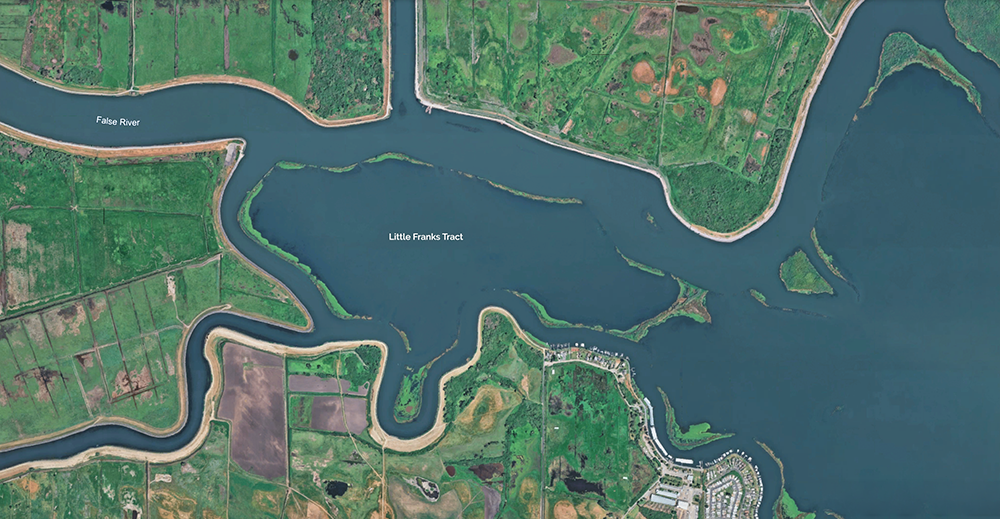
Near Bethel Island, at the mouth of False River, Little Franks Tract covers approximately 330 acres of what was once agricultural land. Today, it lies submerged within the Franks Tract State Recreation Area, managed by California State Parks and accessible only by boat.
Its transformation began after decades of subsidence and levee failures. Severe storms and high tides in the early 1980s breached the remaining levees, allowing water to reclaim land that had sunk below sea level. The state chose not to rebuild the levees, and the former farmland became shallow open water.
This history has created a distinctive restoration challenge. Little Franks Tract is now part of the Delta's complex network of waterways, yet its altered landscape and difficult access make habitat management unusually demanding. Understanding how the site reached its current condition is the first step toward addressing its ecological challenges.
Confronting Invasive Plants
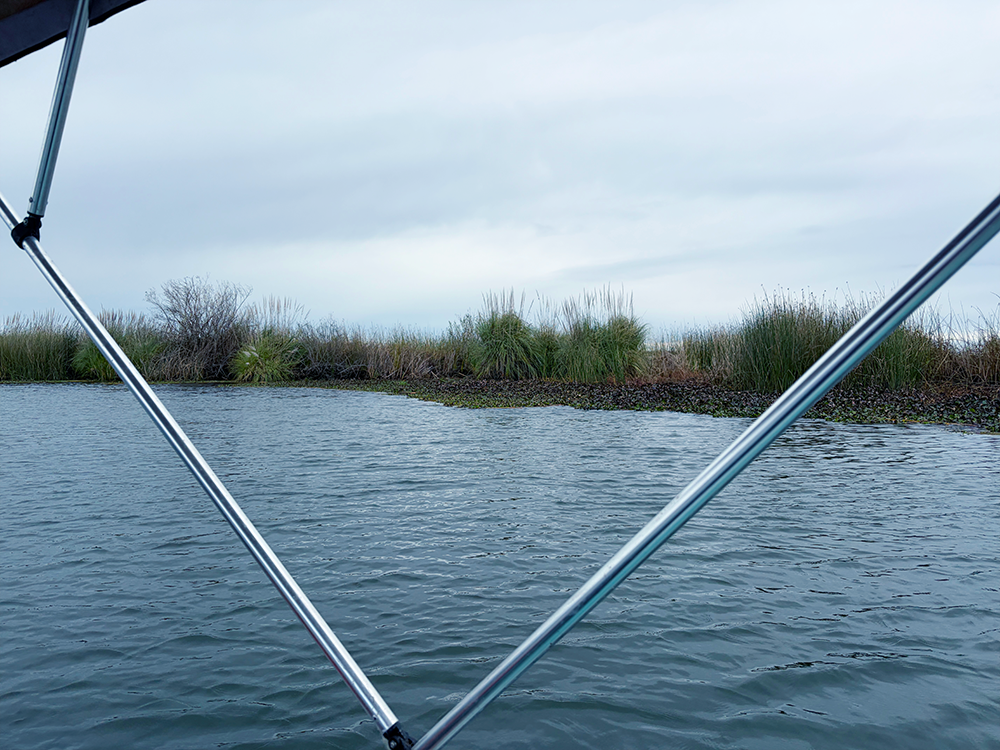
Invasive vegetation is one of Little Franks Tract's most persistent challenges. Giant reed (Arundo donax), Himalayan blackberry, pampas grass and common reed (Phragmites) can spread aggressively, crowding out native plants and changing the structure of the habitat.
At Little Franks Tract, managing these species is complicated by waterlogged ground, submerged areas and the absence of roads or conventional access points. Crews cannot simply drive equipment into the site and work their way across it. Treatments must account for sensitive habitat, difficult footing and the practical limits of reaching isolated patches of vegetation.
CCRCD EcoStewards are helping tackle this challenge through a multi-year habitat management effort with California State Parks, supported by the Sacramento-San Joaquin Delta Conservancy. Their fieldwork focuses on identifying and treating invasive plants while testing methods suited to this unusual environment. The goal is to develop repeatable approaches that can guide continued management.
Giving Native Plants Room
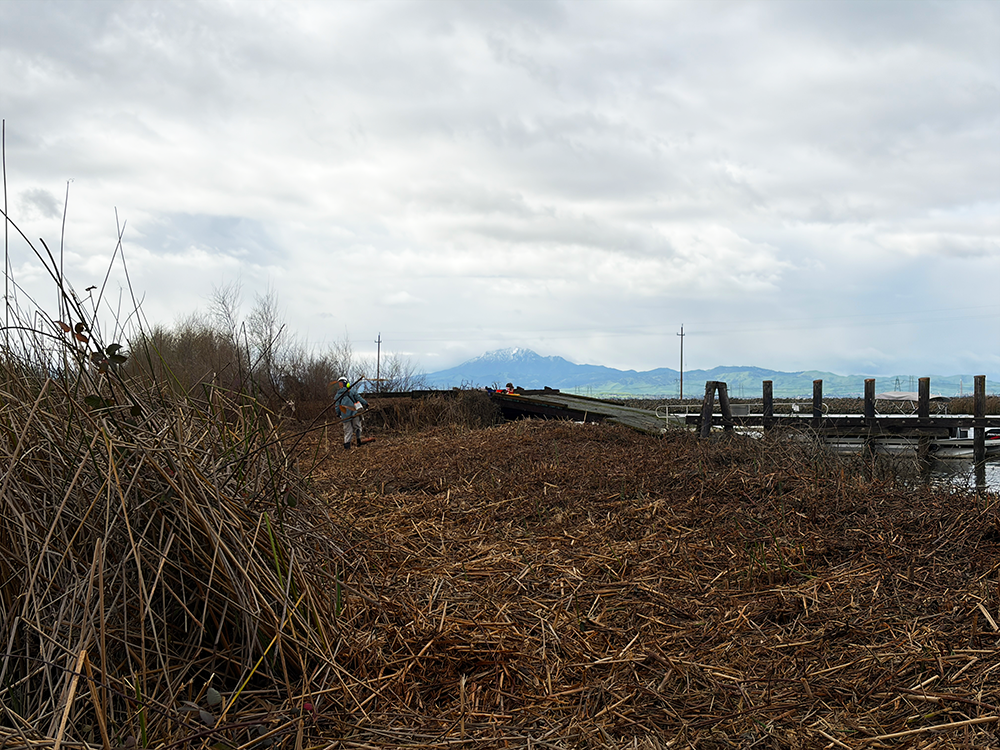
Removing invasive plants is only part of the restoration process. The next challenge is creating conditions where native Delta vegetation can recover and compete successfully.
EcoStewards target aggressive species that overtake the landscape, helping open space for native plants such as tules, California wild rose and willows. These species are valuable components of wetland and riparian habitat, contributing vegetation structure, shelter and resources for wildlife.
At Little Franks Tract, that work requires careful attention to where invasive plants occur and how treatments affect the surrounding environment. Because the land is submerged and access is limited, crews must adapt their methods to the conditions rather than rely on conventional land-based techniques.
Repeated management is also important. Invasive plants can return from surviving roots or established seed banks, so a single treatment may not be enough. By revisiting treated areas and recording results, EcoStewards help determine which approaches are most effective for this challenging Delta landscape.
Restoring Wildlife Habitat
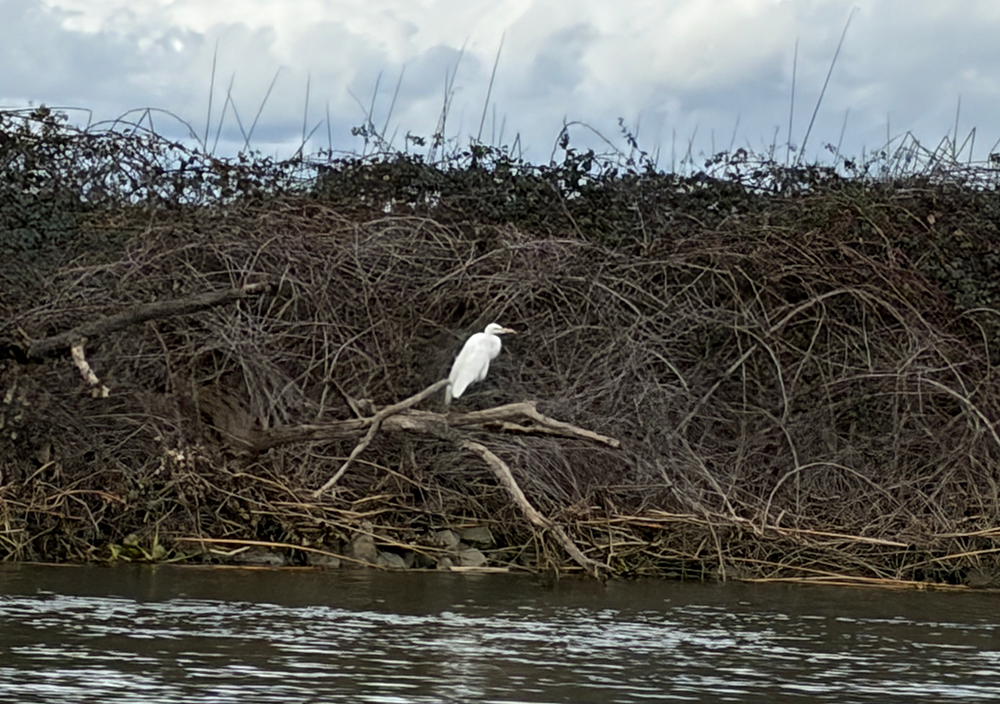
Little Franks Tract's future depends on restoring more than plant diversity. The structure and variety of vegetation also influence which birds and other wildlife can find food, shelter and places to forage.
Dense stands of invasive blackberry and reed can dominate areas that could otherwise support a wider range of habitat. EcoStewards work to manage these growth patterns, helping create a more varied landscape with opportunities for native vegetation to establish. Thickets are not automatically undesirable—some provide useful cover—so management must consider habitat function rather than simply removing every dense patch.
A healthier mosaic of vegetation can benefit songbirds, wading birds and raptors that use the Delta. These improvements also support the broader ecological community on which native wildlife depends.
By documenting vegetation conditions and observing changes after treatment, EcoStewards help connect invasive plant management with the larger goal of improving habitat. Their work lays groundwork for future restoration while recognizing that ecological recovery takes time.
Working Where Roads End
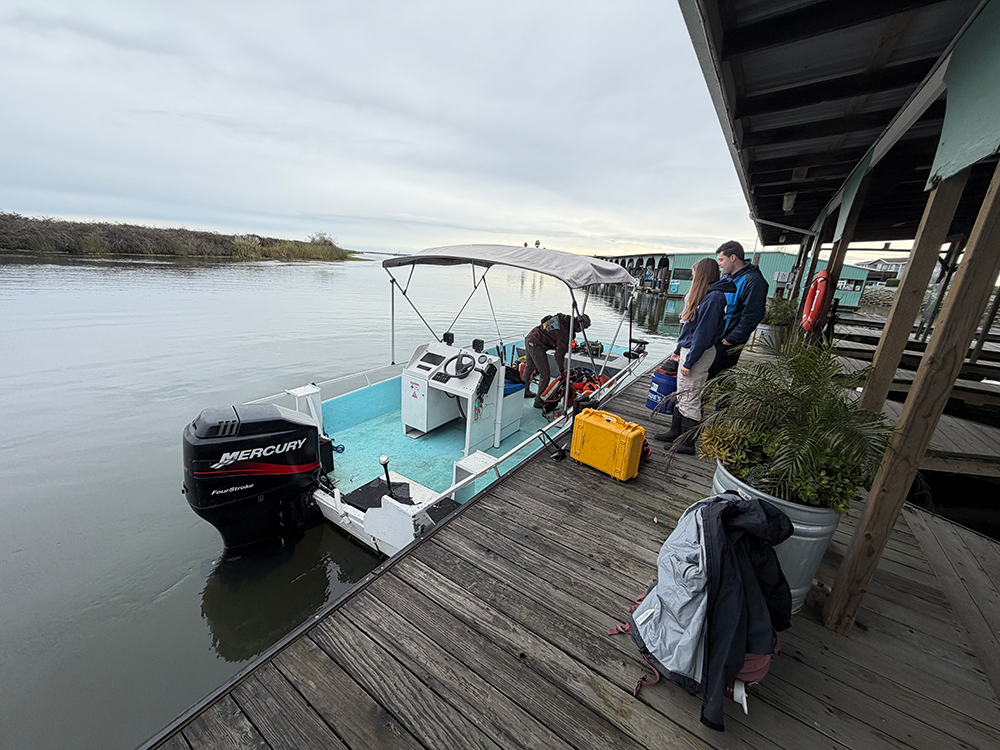
Little Franks Tract presents a logistical challenge unlike a typical restoration site. Much of the ground is submerged or unstable, and the area can only be reached by boat. Carrying tools, transporting crews and safely treating invasive plants requires careful planning.
To meet these conditions, CCRCD EcoStewards and project partners use watercraft and custom-built floating docks as mobile field bases. These platforms provide places to organize equipment and support work in areas that would otherwise be difficult to reach. Crews can move between treatment locations without depending on roads or firm ground.
The approach is part of a broader effort to develop practical methods for managing invasive vegetation in the Delta's subsided, waterlogged landscapes. Every field visit offers a chance to assess access, refine logistics and learn how equipment performs under real conditions.
By adapting restoration work to the site's unique geography, EcoStewards are helping establish methods that may prove useful in other challenging Delta environments.
Mapping the Hidden Problem
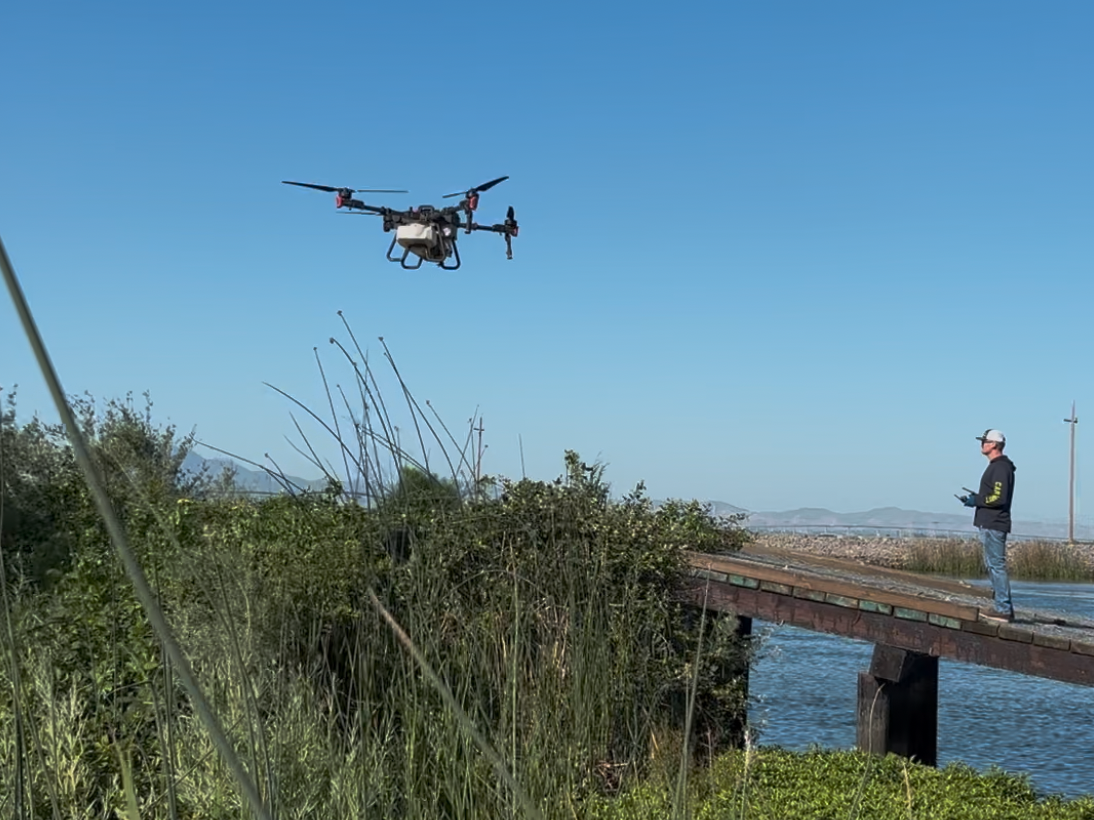
Some invasive plant infestations are difficult to assess from the water. Dense vegetation, unstable ground and limited sightlines can conceal the true extent of a problem, making it harder to plan effective treatments.
To improve this picture, the Little Franks Tract project has used drone technology with support from Central UAS Technologies. High-resolution aerial imagery helps crews identify invasive plant patches, map their locations and plan targeted management. Project surveys have identified more than five acres of non-native vegetation for attention.
Aerial mapping is especially useful when conventional ground surveys are impractical or unsafe. Instead of treating an area without a clear picture of its condition, crews can use imagery to focus their efforts and document where vegetation occurs.
EcoStewards contribute field observations and treatment information that complement these aerial views. Combining on-the-ground experience with drone mapping helps the team build a clearer understanding of the site and develop a more organized, repeatable approach to invasive species management.
Preparing for Future Restoration
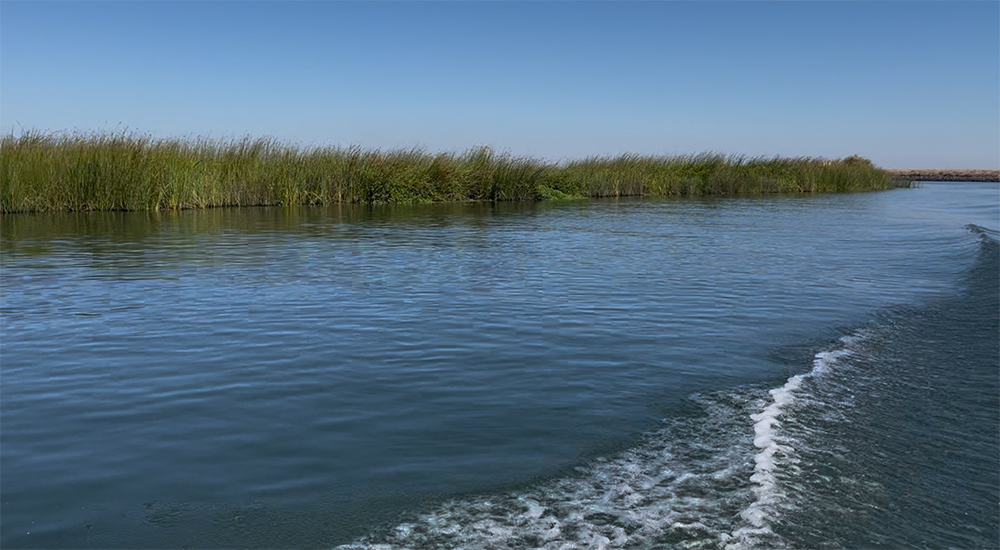
The work at Little Franks Tract is part of a longer effort to improve the Delta's ecological health. Although the site's submerged terrain and invasive vegetation make restoration difficult, addressing these problems now can help create better conditions for future habitat improvements.
CCRCD EcoStewards are helping test management methods, document field conditions and determine how crews and equipment can work effectively in challenging environments. That practical knowledge can inform broader planning efforts, including the Franks Tract Futures initiative, as agencies consider the area's long-term future.
The immediate goal is to prevent invasive plants from overwhelming the landscape and give native vegetation a better chance to establish. Over time, this work can contribute to more diverse habitat and provide valuable lessons for restoration elsewhere in the Delta.
Little Franks Tract shows that conservation does not always begin with a large construction project. Sometimes, progress starts with careful observation, persistent fieldwork and finding workable solutions to a difficult problem.

Ben Weise
Skills: Permitting, conservation on agricultural land, illegal dumping prevention.
Fun Fact: Eagle Scout, former member of the University of California Marching Band, aspiring birder, and a Contra Costa native raised in Southern California.
Ben Weise
Ben started working with Contra Costa RCD in January 2017 after receiving two Masters degrees from Indiana University in Natural Resource Management and Environmental Policy following undergraduate studies at UC Berkeley. Ben manages the Voluntary Local Program, the EcoStewards Program, and other conservation programs focused on agricultural lands.

Adam Gelfand
Skills: Field Data Collection, Tree Physiology, Habitat Monitoring, Outreach.
Fun Fact: Loves to cook Middle Eastern food, surf, write folk music, and doesn't think the wilderness exists.
Adam Gelfand
Adam grew up in New Jersey where they spent their childhood looking for bugs and coming up with new names of plants. Their first ecological position was selling Christmas trees as a teen. Afterwards, they went to Warren Wilson College in Asheville, NC where they spent four years working on an organic vegetable farm and earning a degree in Environmental Education. Seeking a way to be of service during the pandemic, they then moved to New York City to teach conservation biology to communities traditionally underserved by environmental education. Adam has grown to identify as an ecologist and conservationist who sees the world through the eyes of trees. They recently earned a graduate degree where they studied the relationship between Indigenous fire history, carbon sequestration, forest compositional shifts, and tree rings. Adam is excited to join CCRCD and face all the exciting challenges that come with restoring habitats.

Jules Mackey
Skills: Camera trapping, California wildlife and plant identification, data management, conservation education.
Fun Fact: Loves birding, rock climbing, fashion, hiking, and cooking Filipino food.
Jules Mackey
I grew up spending a lot of time exploring nature in my hometown, San Diego, and while camping throughout the western United States.
My passion for conservation led me to pursue an education at UC Davis, where I graduated in 2022 with a B.S. in Environmental Science & Management, and a minor in Wildlife, Fish, and Conservation Biology. Prior to joining CCRCD, I've performed field monitoring in the Delta and Bay area. At CSTARS, I collected GPS points of native and invasive plant species in the Delta in order to develop aerial vegetation identification tools. As a field researcher with the UC Davis Road Ecology Center, I collected camera-trap data and analyzed the impacts of Interstate 580 on East Bay wildlife communities.
I'm driven by a passion for urban ecology, environmental justice, and the restorative power of nature to communities and people. I am excited to bring my skills and passion to my work with CCRCD.

Elena Rich
Skills: California wildlife and plant identification, wildlife camera trapping, heavy equipment and power tool operation, community engagement and education, data management.
Fun Fact: Loves birding, gardening, hiking, tidepooling, and game nights with friends and family.
Elena Rich
Elena grew up in the East Bay and spent much of her childhood hiking and exploring the local oak woodland open space, where her love of nature developed.
Elena is fascinated by the challenge of stewarding habitat in novel ecosystems. She studied at UC Davis, receiving a B.S. in Environmental Science and Management in 2024. While in college, she worked at the UC Davis Arboretum and Public Garden for three years, first at the nursery and later as a waterway stewardship apprentice at the Arboretum Waterway. There, she gained experience in plant care, restoration, wildlife monitoring, and habitat management in a human-dominated landscape.
Elena began working at the CCRCD in 2024. She has enjoyed exploring and stewarding new areas of her home county, such as Dutch Slough in Oakley. Working outside nearly every day, she is grateful to have the opportunity to foster such an intimacy with the ecology of Contra Costa County.

Molly Clemons
Skills: Habitat restoration, invasive weed control, California wildlife and plant identification, natural resource management, ArcGIS mapping software.
Fun Fact: Enjoys hiking, birding, gardening, and kayaking
Molly Clemons
Molly is an Ecosteward Conservation Technician. She received a B.S. in Environmental Science at Sonoma State University in 2023. She served with AmeriCorps, California Climate Action Corps at St. Mary's College in Moraga CA, during the past year. As a California Climate Action Corps fellow her primary duties were in garden management, education, and community engagement.